Simon Willison had Claude Code build Beep Locator, turned phones and tablets into a microphone array, and found the beeping carbon-monoxide alarm with a low battery in his storage room to within 40 cm
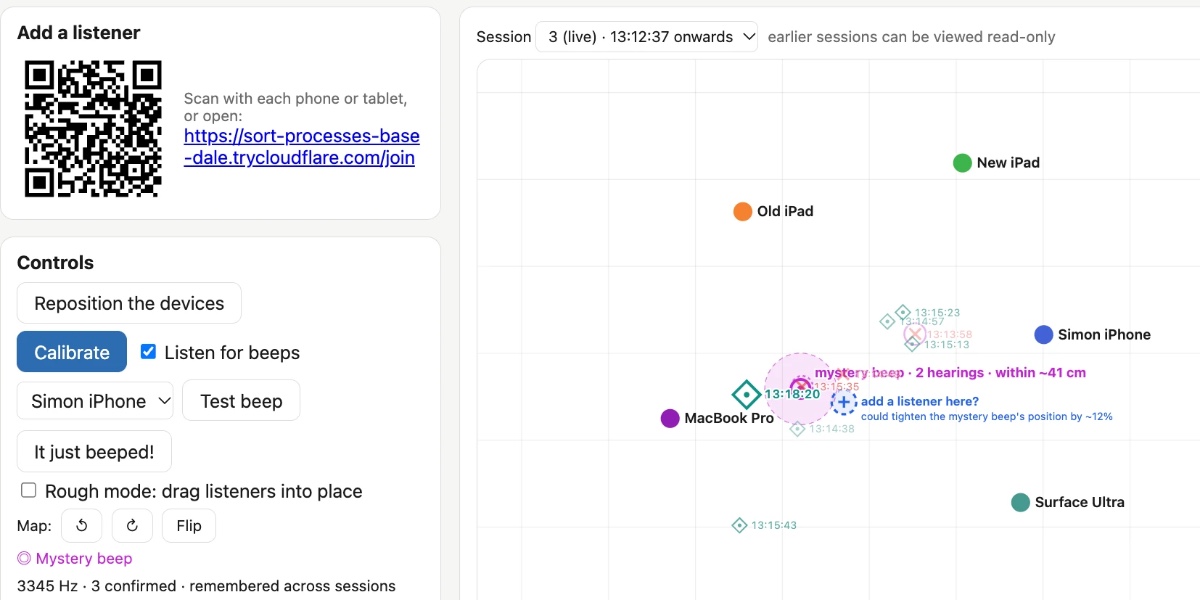
After a move, something in a box room started beeping at long intervals—too sparse to locate by ear, and Simon Willison (@simonw) did not want to unpack every box. On his phone he used Claude Code Cloud (Opus 5.5, Extra thinking) against an empty repo to write up the problem, then had it build a Python web app: one device opens a coordinator page, and phones, tablets and laptops join in the browser as listeners, sending audio to the server over WebAudio and WebSockets. Letting the devices locate each other by chirping was inaccurate, so he added a Rough mode for dragging icons into approximate positions, plus a clap test (a different map symbol) to check that localization worked at all. When a beep appeared he could replay each device’s clip and mark “this is the mystery beep,” after which the system tightened the estimate from frequency and interval. He reports it got within about 40 cm, and in that pile of boxes he found an old carbon-monoxide alarm that needed new batteries. Mid-project, Fable 5.2 shipped and he continued on his laptop, chatting with the model while the server ran; listener pages can also hot-swap JavaScript over the WebSocket so you don’t reload and re-grant the microphone. We cloned simonw/beep-locator 0.1.0 (449a488, Apache 2.0); uv run pytest passed all 26 tests in 2.63s (plus one Starlette/httpx deprecation warning). After uv run beep-locator serve on local port 8765, the coordinator page, /join and /sim each returned HTTP 200. We did not triangulate with real devices, and we did not start a Cloudflare tunnel.
Visit site Beep Locator (Claude Code) ↗- Pricing
- Free
- Region
- Global
- Where it's from
- Overseas
- Added
- Nov 11, 2026
- Tested on
- Nov 11, 2026
- Version we used
- beep-locator 0.1.0 (git 449a488); uv run pytest / uv run beep-locator serve on CPython 3.13.5
- Categories
- CodingAutomation & Agents
- Original author
- Simon Willison @simonw ↗
- Our test
- Partly tested
- Cost / time
- The repo is Apache 2.0 and the software itself is free. You need Python (the project asks for ≥3.10, with dependencies installed via uv) and at least three devices that can open a browser and a microphone. Phone https often uses a Cloudflare quick tunnel (cloudflared), under Cloudflare’s current terms. Model spend comes from a Claude subscription you already have; if you only run the published repo and don’t keep asking a model to change the code, you may incur no new model bill.
The task
Without unpacking a room of boxes, turn the phones, tablets and laptops you already have into a microphone array and narrow an intermittent beep down to a spot you can actually search.
Steps
- You need uv (https://docs.astral.sh/uv/). Phone browsers generally require https for the microphone: install cloudflared (on macOS, brew install cloudflared) or use --https on a LAN. Then: git clone https://github.com/simonw/beep-locator && cd beep-locator && uv run beep-locator serve --tunnel.
- The terminal prints a coordinator URL (it includes the admin token—open it only on your laptop), a join URL, and a QR code. Place at least three devices around the room (volume up, silent mode off, no Bluetooth speakers, plugged in, screen on with the page in front). The coordinator laptop can also tap “Also listen on this device.”
- Press Calibrate: each device chirps in turn and the map shows relative positions. Distances can’t tell a room from its mirror image, so rotate/flip the map to match the real room. Test beep makes one device play a fake beep, which should be located on top of that device—a quick accuracy check.
- Leave Listen for beeps on. When a real beep is heard, one device plays a sync chirp, every device uploads the surrounding audio, and an estimate appears on the map; further beeps tighten the shaded region. Clap mode lets you rehearse by clapping around the room. If ranging is messy, drag devices in Rough mode to approximate positions and continue.
- To try the flow without hardware, open /sim (for example /sim?n=5&every=10&bx=3&by=2) for a simulated room and beeper. We did not run a real multi-device capture. Treat the admin token like a password—don’t paste it into chat or a screenshot.
Prompt
Write out a problem.md file describing the problem we want to solve

There is a device beeping in a room and I cannot find it

I want to set up several devices - laptops, phones, iPads - around the room all listening at the same time and have them help triangulate where the beep comes from

There needs to be a Python web app which coordinates it all - one device shows a web page for the app, other devices join a URL which turns them into listeners - all via browser WebAudio and WebSockets back to the Python server app

Ideally I wouldn't need to manually input the relative locations of the devices - it would be amazing if they could play sounds to each other in order to locate each other in 2D space - is that even possible though?
What the author says
Simon Willison @simonw (blog 9 Nov 2026, X post 10 Nov 2026): an intermittent beep in a box room was too sparse to hunt by ear, and he didn’t want to unpack. He started from an empty repo in Claude Code Cloud on his phone (Opus 5.5, Extra thinking) with the prompt above; Claude also found the 2007 BeepBeep acoustic-ranging paper. Listeners keep a ~60s audio buffer and detect beeps with an FFT plus a high-pass filter; when one is reported, the server has the lowest-RTT device play a sync chirp and every listener uploads from about 0.6s before the beep to 0.8s after that chirp so the clips can be aligned. Chirp-based self-localization was weak, so he added draggable Rough mode; clap tests show as diamonds on the map. After the system got within about 40 cm, he found an old carbon-monoxide alarm that needed batteries in that pile of boxes. He then continued on his laptop with newly released Fable 5.2 against the live server (rough dragging, clap symbols, timestamps, per-device replay, a “this is the mystery beep” button, repositioning without restarting devices, and a suggested extra-listener spot). Listeners expose installModule() so new JavaScript can be pushed over the WebSocket without reloading and re-granting the microphone.
Our test
On 11 Nov 2026 on Linux we git-cloned https://github.com/simonw/beep-locator (449a488; pyproject version 0.1.0; Apache 2.0 LICENSE). We read the README, problem.md and the tests. In the repo’s uv environment, uv run pytest reported 26 passed and one StarletteDeprecationWarning (httpx with starlette.testclient) in 2.63s. We then ran uv run beep-locator serve on the default port 8765 without a tunnel: the process printed coordinator, /join and /sim URLs; curling the coordinator returned HTTP 200 and 3434 bytes (title Beep Locator), and /sim?n=5&every=10&bx=3&by=2 returned HTTP 200 and 4419 bytes. We did not install cloudflared, attach a real microphone array, or run calibration or a live locate. We stopped the local server afterwards.
What we found when we tried it:All 26 unit tests in 0.1.0 (DSP and server, including the /sim virtual room) passed on this machine. Without a tunnel, the local HTTP server does serve the coordinator and the simulated room; the README’s note that phones need https matches the fact that we only exercised the local pages.
How to get in
The write-up and code are public worldwide: https://simonwillison.net/2026/Nov/9/mysterious-beeps/ and https://github.com/simonw/beep-locator . No account is required. Phone microphones commonly use a Cloudflare quick tunnel; if cloudflared is unreliable on your network, use --https on a LAN, or your own reverse proxy, and set --public-url to an address the phones can open.
Who it suits
Anyone with an intermittent alarm or gadget beep and a few spare phones or tablets; also developers who want to see a coding agent grow “ears” and iterate on a real room. A single computer, or no way to give phones an https microphone, is not enough for a full locate (you can still open /sim for a demo).
Pitfalls
- Letting devices locate each other by chirping alone was inaccurate; Simon switched to rough dragging plus a later correction.
- Phone microphones usually need https; a server on http://localhost will not let phones join.
- Bluetooth speakers, silent mode, a locked screen or sending the page to the background can break capture or clocks.
- The admin token in the coordinator URL controls the whole system (including pushing code to listeners)—don’t post it in public.
- We only ran the unit tests and local pages; we did not reproduce the 40 cm locate with real devices.
Images
More in this category
- A demo video per docs page that flags itself when the UI changesVideoScreenplayClaude CodeTool free; uses your agent's quota◐ Partly testedOverseas
- AI backend code that guards against races, leaks and bad migrationsCodingbackendskillsClaude CodePostgreSQLFree; about 2× tokens per task◐ Partly testedOverseas
- An afternoon of AI work, a 3D action game you play in the browserCodingClaude CodeTripoJimengSkill free; Claude quota plus asset tools◐ Partly testedChina
- Keep a long-running AI-built project from turning into a messCodingClaudeCodexoil-delegateNeeds Claude and Codex plans◐ Partly testedChina
- Use a web app once and get an AI write-up of how it worksResearchREAClaude CodeChromeFree tools; needs Claude or Codex◐ Partly testedOverseas